Felfel vs Qibi vs Feel Eat: the complete guide to the connected fridge in companies in Switzerland

In a few years, the connected fridge in the company has become a category in its own right on the Swiss market of collective catering. Where the snack vending machines dominated undivided, three players today structure this landscape in French-speaking Switzerland: Felfel, the Zurich pioneer, Qibi, the alternative based in Geneva and Zurich, and Feel Eat, the Neuchâtel challenger.
If you are actively evaluating these solutions for your teams, or if you are already a client of one and you wonder whether the other would suit you better, this article is designed to give you, in a clear and factual format, the whole of the elements that really count: the purchase technology, the model of culinary production, the food offer, the prices and the contractual conditions.
This article is written by the teams of Qibi (GreenTime SA). We have made the choice of a transparent and sourced comparison. The information relating to Felfel and Feel Eat comes exclusively from their respective official websites, the app stores, the Swiss economic press and published customer testimonials. When a point cannot be verified publicly, we specify it.
Why the connected fridge is establishing itself in Swiss companies
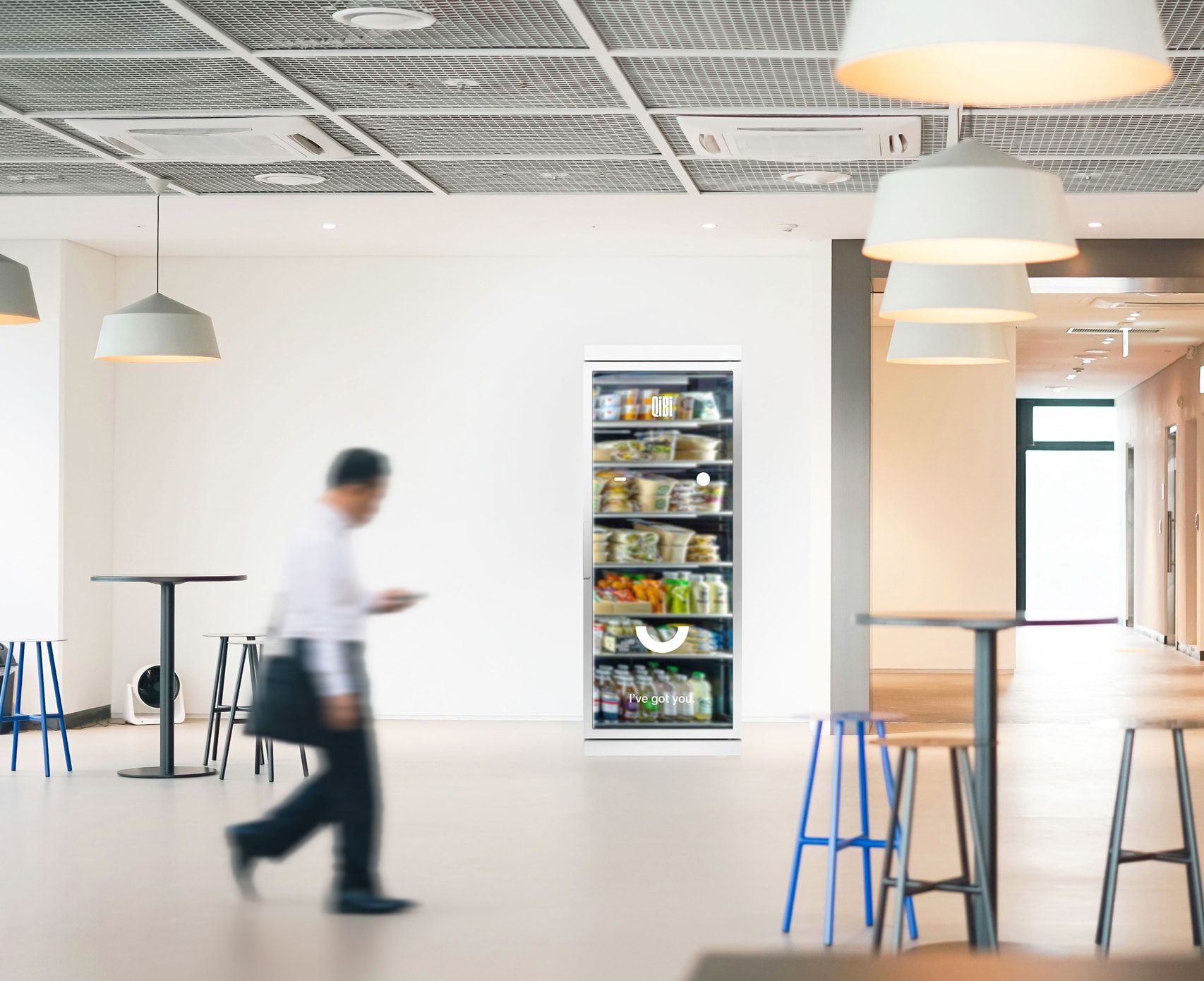
The Swiss market of company catering is going through a deep transition. The internal canteens are costly to operate for the SMEs, the snack vending machines no longer meet the nutritional expectations, and the delivery of individual meals suffers from the limited break time. The connected fridge brings a hybrid answer: fresh cooked meals, accessible on site, without service staff, 24/24.
Three structural factors accelerate this adoption.
First, the growing awareness of the link between food and productivity. The HR management no longer considers the midday break as a peripheral topic, but as a direct lever of quality of life at work (QVT), employer brand and loyalty.
Then, the breaks are more and more short. 30 to 45 minutes of break, of which 10 to 15 lost going out, that is the reality of the majority of the employees of SMEs. A fridge on site is between 15 and 25 minutes recovered per day.
Finally, the evolution of environmental expectations. Carbon footprint, waste, packaging: the CSR departments now integrate catering into their annual reporting. The three players studied here all position a sustainable approach, but with different angles.
Presentation of the three players of the French-speaking Swiss market
Felfel: the Zurich pioneer
Founded in 2013 in Zurich by the entrepreneurial couple Daniela and Emanuel Steiner, Felfel AG laid the foundations of the market of the connected fridge in the company in Switzerland. The name "Felfel" means "pepper" in Persian, in tribute to the family history of the co-founder.
The company today claims more than 1,000 equipped locations across the whole of the Helvetic territory, and employs between 101 and 250 employees. The head office is at Räffelstrasse 24, 8045 Zurich. An operational branch was opened in Lausanne in 2018 to extend the presence in French-speaking Switzerland. In 2024, the brand initiated its international expansion with the opening of offices in New York. In 2022, it bought out its local competitor Snäx.
Qibi: the alternative with double establishment
Qibi is a brand operated by GreenTime SA, a Swiss company founded in 2017. At its head, Antoine Comina, an entrepreneur passionate about cooking who went through finance, who made the bet of catering as early as 2011. It is this double culture, rigour of the figures and demand of eating well, that shaped the choice of an integrated internal production.
Its head office and its main production laboratory are in Vernier (Geneva). A second laboratory, doubled with an office and a logistics hub, operates in Zurich. This double establishment, which favours a strong French-speaking anchoring while covering the German-speaking region, is one of the structural specificities of the company.
Qibi made the choice of the integrated internal production: all the dishes of the catalogue are cooked daily by the brigades of chefs of the company, in its own laboratories. The catalogue counts 250 recipes, with a weekly menu of 20 dishes (about thirty recipes in total with the snacks and side dishes) that rotates each week. Among the reference clients figure Adecco, FIFA, Deloitte or Le Temps.
Feel Eat: the Neuchâtel challenger
Feel Eat is a Neuchâtel company (head office: Av. de Clos-Brochet 10, 2000 Neuchâtel) founded by Marco Barboza, a passionate chef originating from Rio, who worked in Switzerland, in the United States and in the United Kingdom before creating Feel Eat. The company today claims more than 150 client companies and more than 32,000 satisfied users.
Its distinctive signature: the reusable glass containers, washable to infinity, as a total replacement of plastic packaging. The menu offers 35 weekly recipes from an international cuisine (Italian, Brazilian, Syrian chefs), with a claimed approach of organic, local, homemade and zero waste.
Technological comparison: fluidity of purchase and infrastructure
This is probably the most differentiating point between the three solutions on a daily basis, and the one that is felt the most in the use of the employees. The purchase time in front of the fridge is not anecdotal: multiplied by the number of weekly transactions, it represents a significant accumulation of minutes, and of friction perceived by your teams.

Felfel's scan-and-pay
The Felfel system relies on a protocol of scan-and-pay. Concretely:
- The employee unlocks the fridge via their physical RFID badge or via the mobile application (Bluetooth Low Energy).
- They open the door, select their items.
- They close the fridge again, then go in front of the integrated touchscreen terminal.
- They manually scan the barcode of each item via the laser reader.
- They validate their basket on the touchscreen.
The payment is then debited via the registered mode (Mastercard, Visa, Amex, TWINT, PostFinance, Lunch-Check, Reka).
Feel Eat's scan-and-go
Feel Eat offers a simplified system of scan-and-go via the application:
- The employee opens the fridge via the Feel Eat mobile application.
- They choose their dish, scan the code of the item via their telephone.
- They validate their purchase basket.
- The payment is done automatically by topped-up account or Lunch-Check.
- They take the dish and close it again.
The scan is done via the personal telephone, which removes the step of the touchscreen terminal but keeps a step of manual scan per item.
Qibi's RFID technology
Qibi's approach is different. Each package is equipped with an integrated RFID chip:
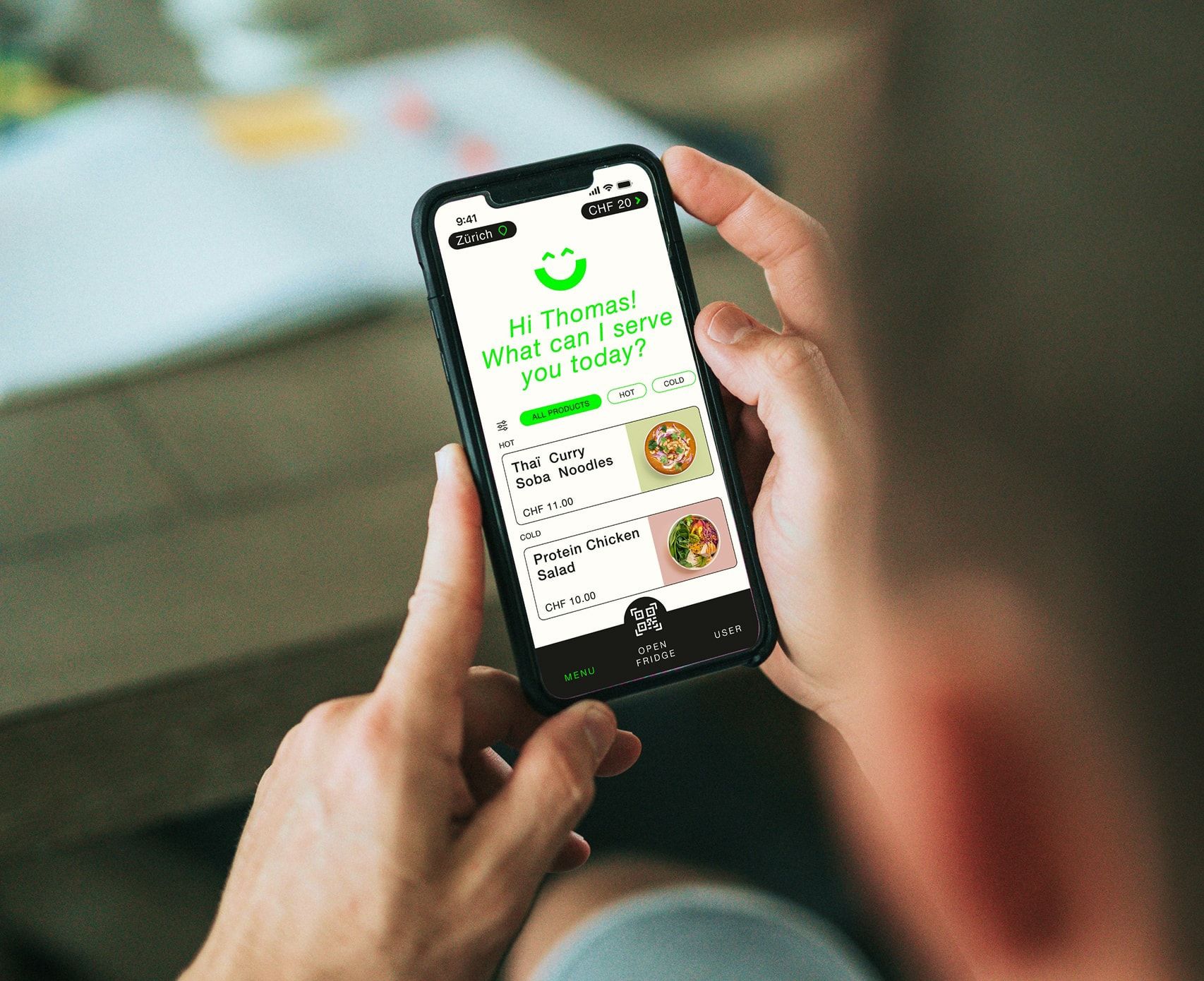
- The employee opens the fridge via the Qibi application (a single QR scan at opening).
- They take the items they wish.
- They close the fridge again.
At closing, the system automatically identifies the items taken by RFID reading and debits the account instantly. There is no scan item by item. The experience holds in three moves: open, take, close.
The RFID technology, long used in logistics and mass distribution, allows the identification of objects without contact or line of sight. Applied to self-service catering, its objective is to reduce as much as possible the time and the friction of the moment of purchase, particularly useful for the environments with high throughput or with short breaks.
Table 1: comparison of the technological infrastructures
| Technical component | Felfel | Qibi | Feel Eat |
|---|---|---|---|
| Access to the fridge | Physical RFID badge or mobile app (Bluetooth) | Mobile application (QR scan) | Mobile application |
| Payment technology | Scan-and-pay: manual scan of each item on a touchscreen terminal | RFID: automatic identification of the items at closing | Scan-and-go: scan per item via telephone |
| Number of steps per purchase | 5 steps | 3 steps | 5 steps |
| Touchscreen terminal on the machine | Yes (mandatory) | No | No |
| Proprietary system | Yes | Yes | Yes (claimed) |
| Means of payment | Mastercard, Visa, Amex, TWINT, PostFinance, Lunch-Check, Reka | Card registered via the app, automatic debit | Topped-up account, Lunch-Check, various |
Comparison of service: culinary production and logistics
If the technology determines the purchase experience, the production model determines the quality on the plate. It is on this point that the three companies diverge the most strongly in their philosophy.

The Felfel model: a network of culinary partners
Felfel does not operate its own centralised kitchen to prepare its meals. The brand collaborates with a network of about a dozen caterers, artisan bakers and partner restaurants: Tibits, Nagomi, Pastificio di Bellinzona, the Laiterie de Grandvillard, among others.
The recipes are co-created under the supervision of an internal team of "Food Scouts". The menu offers daily more than 10 options for the midday meal, with a weekly rotation of about 25 different menus.
The advantage: the cultural diversity of the dishes, inherited from the diversity of the partners. The counterpart: a dependence on the planning of each caterer, and a lesser direct mastery over the production processes.
The Feel Eat model: internal international cuisine
Feel Eat operates a homemade kitchen from its site of Neuchâtel. The cultural signature is strong: a team of chefs of diverse origins (Italian, Brazilian, Syrian) cooking authentic dishes. 35 weekly menus are offered, delivered daily by the Feel Eat teams.
The zero-waste commitment is central: all the dishes are served in reusable glass containers, washed and reused to infinity. The unsold items are first redistributed to schools at half price, then given to associations.
The Qibi model: integrated internal production with double site
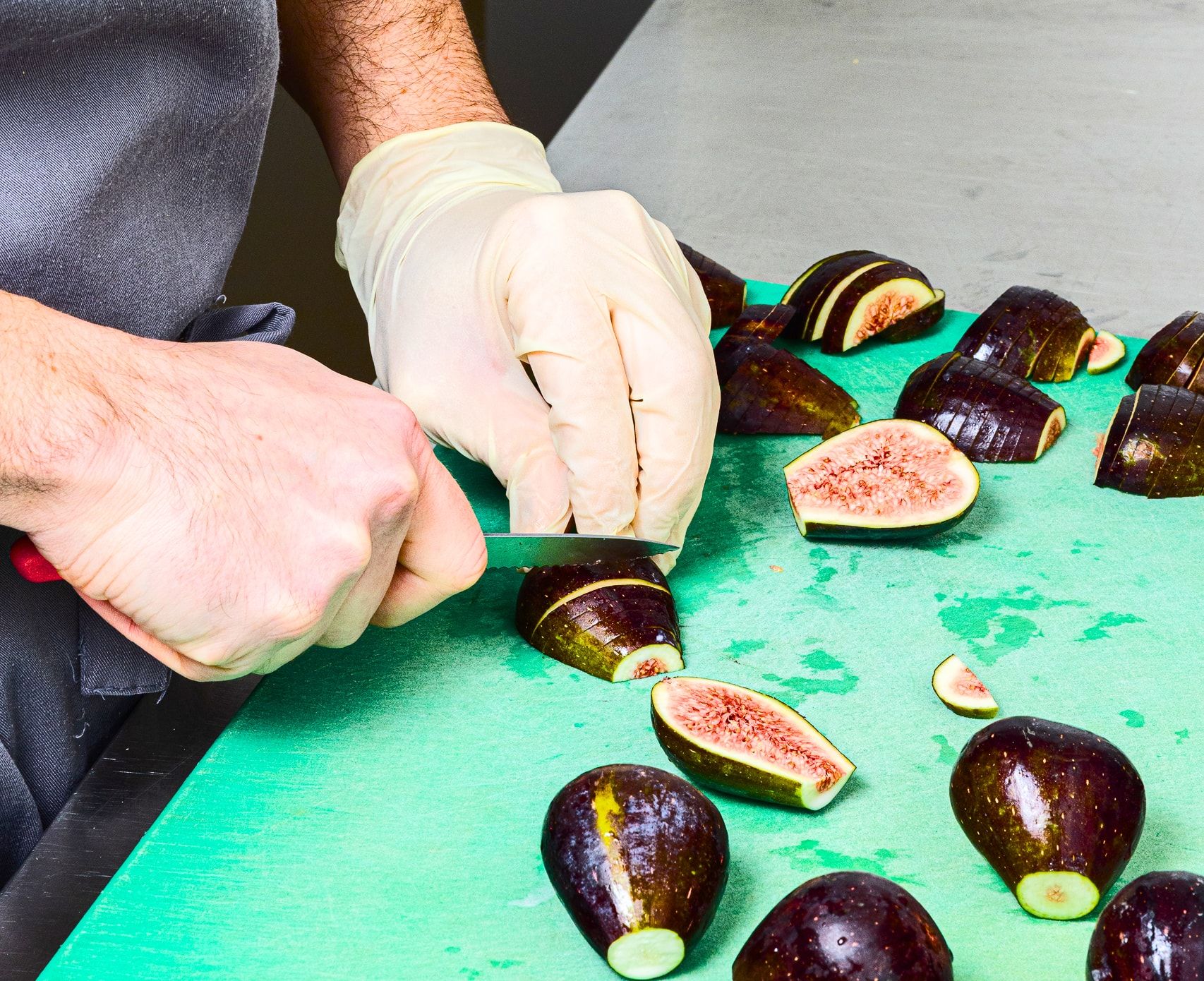
Qibi made the choice of complete vertical integration. All the dishes of the catalogue, that is 250 recipes, are prepared internally, every day, in the two production laboratories of Geneva (Vernier) and Zurich, by the teams of chefs employed directly by the company.
Concretely, this means:
- Daily restocking of the client sites, from Monday to Friday
- Complete mastery of the sourcing of the raw materials
- Capacity to adjust the recipes quickly according to the employee feedback
- Consistency of execution over the whole of the menu
This integration has a direct consequence on the freshness: the dishes consumed on a Tuesday were cooked on Monday evening or Tuesday morning, from the laboratory closest to your site.
Table 2: comparison of the service models
| Logistical dimension | Felfel | Qibi | Feel Eat |
|---|---|---|---|
| Origin of the production | Network of partner caterers (~10 players) | Teams of internal chefs, Geneva + Zurich laboratories | Internal Neuchâtel kitchen |
| Own centralised kitchen | No | Yes (2 sites) | Yes (1 site) |
| Rhythm of delivery | Planned according to consumption | Daily (Mon-Fri) | Daily |
| Weekly variety | ~25 dishes | 20 dishes / 250 in the catalogue | 35 menus |
| Geographic coverage | Whole of Switzerland (Zurich + Lausanne) | French-speaking + German-speaking region | French-speaking region as priority |
| Containers | Standard | PLA (of plant origin) | Reusable glass |
| Management of unsold items | Half-price Happy Hour from 3 pm + associations | App notifications, reduced prices, schools, Too Good To Go + associations | Schools at half price + associations |
Comparison of the gastronomic and nutritional offer
Beyond the number of dishes, the nutritional rigour and the sourcing of the ingredients are criteria that weigh more and more in the decision of the client companies, notably on the CSR and employer-brand aspects.

Variety and dietary options
Felfel offers more than 10 main dishes per day, with about 25 menus in weekly rotation. The vegetarian, vegan, gluten-free and lactose-free options are indicated on the packaging and in the app.
Feel Eat offers 35 weekly menus with a marked international signature. The specific diets (vegan, vegetarian, gluten-free, lactose-free, pesco, etc.) are identified via a pictogram system developed internally, which also includes the allergens (gluten, lactose, lupin, soy, sesame, eggs, etc.).
Qibi relies on a catalogue of 250 recipes, with a weekly selection of 20 dishes that rotates. The formulations are validated by specialists in nutrition. The specific diets are identified at purchase and designed from the recipe phase.
The role of nutritional expertise in the design of the dishes
One of the advantages of an integrated internal kitchen holds in the design itself of the recipes. At Qibi, the menus are developed with the support of a nutritional expertise, which allows to balance intake, freshness and pleasure from the phase of creation, and not as a constraint added afterwards.
Labels, certifications and sustainable approaches
Each of the three players claims a local commitment, but with distinct signals.
| Commitment | Felfel | Qibi | Feel Eat |
|---|---|---|---|
| Certified meat of Swiss origin | Yes | Yes | Yes |
| Bio Suisse | According to partners | Yes | Organic claimed (label to confirm) |
| Demeter | No | Yes | No |
| IP-Suisse | No | Yes | No |
| Suisse Garantie | No | Yes | No |
| MSC (sustainable fishing) | No | Yes | No |
| GRTA (Geneva) | No | Yes (Geneva site) | No |
| Containers 100% reusable glass | No | No | Yes (signature) |
| Claimed zero-waste approach | Redistribution of unsold items | Too Good To Go recovery | Core of the positioning |
Reading of the table: the mentions "No" mean that these certifications are not centrally claimed on the respective official websites. The players may have other certifications via their individual partners, but these are not highlighted publicly.
Comparison of prices and contractual conditions
This is often the question that comes first, and that the three players treat with a certain restraint in their public communication.
The cost for the employees
| Type of dish | Felfel | Qibi | Feel Eat |
|---|---|---|---|
| Main midday dishes | CHF 7.50 to 13.90 | CHF 10.– to 12.50 | CHF 8.– to 15.– |
| Simple / starter dishes | From CHF 6.– | Not communicated | From CHF 8.– |
| Snacks and starters | From CHF 1.50 | From CHF 3.– | Variable according to offer |
| Happy Hours unsold items | At half price from 3 pm | App notifications, reduced prices, schools | At half price for the students and the schools |
| Employer subsidy | Customisable tools | System integrated into the app | Possible (claimed) |
| Loyalty program | "FELFEL Loyalty Program" (vouchers CHF 5.–) | Integrated system | Claimed loyalty program |
The cost for the company
None of the three players publishes its company tariffs in a transparent way on its official website. This practice is consistent with the bespoke character of B2B contracts in collective catering: number of sites, consumption profile, technical configuration, chosen formula (with or without employer subsidy, CSR options), all these factors influence the final quote. For a precise costing, it is necessary to request a demonstration and a personalised quote from each player.
Contractual commitment
The conditions of length of commitment and of termination are published by none of the three players. Several customer testimonials published online mention, on the Felfel side, termination notice periods that can reach 12 months, without this constituting official information.
Qibi and Feel Eat offer flexible contractual conditions, including initial phases of trial or tasting, allowing the company to evaluate the real adherence of its employees before any long commitment.
How to choose: decision criteria according to your company profile
Beyond the comparison tables, the good choice depends on the specific context of your company. Here are a few orientation markers according to the profiles that we meet the most frequently.
You are a French-speaking Swiss SME of 50 to 300 employees
You are probably looking for a proximity partner, capable of reacting fast, of coming to present its dishes on site, and of personalising the offer to your team. The three players have a French-speaking presence, but with different anchorings:
- Qibi: head office and main laboratory in Vernier (Geneva), direct proximity with the Lake Geneva arc
- Feel Eat: head office in Neuchâtel, solid base for the Jura arc and northern Vaud
- Felfel: Lausanne branch since 2018, French-speaking coverage delegated from Zurich
You manage several sites in German-speaking and French-speaking Switzerland
Felfel has the densest national network (1,000 locations and more), which constitutes a logistical advantage on a large-scale multi-site deployment. Qibi, with its two laboratories of Geneva and Zurich and its internalised logistics, covers the two language regions while remaining competitive on the medium-sized multi-site configurations. Feel Eat is positioned primarily on the French-speaking region.
You put the user experience at the heart of your QVT approach
If reducing the friction of the moment of purchase is important for you (teams in production with short breaks, environments with high throughput, will to make the midday break more fluid), the technological difference is concrete. Felfel and Feel Eat keep a step of manual scan per item (on a touchscreen terminal for Felfel, via telephone for Feel Eat). Qibi eliminates this step entirely thanks to the RFID technology.
Your priority is environmental commitment
The three players have a built CSR aspect, with different angles:
- Feel Eat puts the reusable glass containers at the heart of its identity, strong signature on the zero plastic waste
- Qibi capitalises on its multiple certifications (organic, Demeter, IP-Suisse, Suisse Garantie, MSC, GRTA) and the mastery of its internal supply chain. The choice of packaging in PLA rather than glass aims to lighten the carbon footprint of the daily deliveries, a container in glass being able to weigh up to ten times more
- Felfel works via its local sourcing partners and an approach of redistribution of the unsold items
According to whether your CSR priority is the "zero packaging waste", the "certified sourcing" or the "recovery of unsold items", the arbitration will not be the same.
You appreciate a marked international cuisine
Feel Eat highlights an international culinary identity (Italian, Brazilian, Syrian chefs). Felfel relies on its diversity of partner caterers. Qibi offers a broad catalogue of 250 recipes from an internal team of chefs.
You are coming out of an unsatisfactory contract with a current provider
The three players offer tastings without commitment to allow you to really test the solution before any deployment. It is the best way to evaluate the reality of the service beyond the commercial brochures.
Request a Qibi tasting on site, without commitment
FAQ: everything to know about the connected fridges in the company in Switzerland
What is the difference between Felfel, Qibi and Feel Eat?
Felfel is the Zurich pioneer (2013) with the largest national network and a model based on a network of partner caterers. Qibi (Vernier/Geneva and Zurich, 2017) operates an integrated internal production with an RFID technology that eliminates the step of manual scan. Feel Eat (Neuchâtel) offers a homemade cuisine with international signature in reusable glass containers.
What is the technological difference between the RFID of Qibi and the scan of the other players?
The Qibi system relies on RFID tags integrated into the packaging, which automatically detect the items taken at the closing of the door. The debit of the account is done instantly, without an additional step. Felfel uses a scan-and-pay where the employee must manually present the barcode of each dish in front of a reader on the machine. Feel Eat uses a scan-and-go via telephone where each item is scanned by the employee in the application.
Where are the meals offered by the three players cooked?
Qibi prepares its meals internally, in Vernier (Geneva) and in Zurich, by its own teams of chefs. Feel Eat also cooks internally, from its site of Neuchâtel, with an international team of chefs. Felfel collaborates with a network of about a dozen caterers, bakeries and partner restaurants that prepare the dishes under the supervision of its Food Scouts team.
What is the price of a midday meal for an employee?
At Qibi, the main dishes are situated between CHF 10.– and CHF 12.50. At Felfel, the range extends from CHF 7.50 to CHF 13.90 (from CHF 6.– for the simple options). At Feel Eat, the prices are staggered from CHF 8.– to CHF 15.–.
Which players are present in French-speaking Switzerland?
The three players are present in the French-speaking region. Qibi has its main head office in Vernier (Geneva). Feel Eat is based in Neuchâtel. Felfel has an operational branch in Lausanne opened in 2018, its main head office remaining in Zurich.
How does the restocking of the connected fridges take place?
Qibi ensures a daily restocking (Monday to Friday) from its production laboratories. Feel Eat also delivers every day from Neuchâtel. Felfel plans its deliveries according to the consumption observed on each site.
What are the termination conditions of a contract of connected fridge?
The precise conditions are published by none of the three players. Qibi and Feel Eat offer phases of trial or tasting without long commitment allowing an evaluation before deployment. For Felfel, the conditions are established bespoke according to the configuration of the company.
How are the food surpluses managed?
Felfel applies an automatic half-price Happy Hour from 3 pm, complemented by a redistribution to partner food banks. Qibi notifies the promotions via its application and puts to use the unsold items via partner schools, Too Good To Go and local associations. Feel Eat first redistributes to schools at half price, then to associations.
Which solution to favour to reduce the waste of the packaging?
Feel Eat distinguishes itself on this criterion with its reusable glass containers, washed and reused to infinity, which constitute the core of its zero-waste positioning. Qibi made the opposite choice, packaging in PLA (plastic of plant origin): a container in glass weighs up to ten times more, which weighs down the carbon footprint of the daily deliveries. Two philosophies of the sustainable coexist here, the reuse of the container for Feel Eat and the lightening of the transport for Qibi. Felfel uses standard packaging with an approach of recovery of the unsold items.
Can you test a connected fridge before signing a contract?
Yes. The three players offer tastings on site allowing the employees to test the dishes before any commitment. It is the best way to evaluate the reality of the service beyond the commercial brochures.
Evaluate Qibi for your company: request a free tasting
You now have the factual elements to make your choice between the three main solutions of connected fridge in French-speaking Switzerland. The best way to decide remains to taste the dishes on site, with your teams, in your break space.
Qibi organises tastings on site without commitment, led by our commercial teams. You will be able to test the application, exchange with your employees, and obtain a personalised costing adapted to your configuration.
To go further
- Discover how the Qibi connected fridge works
- See the Qibi Food offer: the fresh meals cooked by our chefs
- Download the Qibi application
- Consult our support and complete FAQ
Article written by the teams of Qibi (GreenTime SA). Public sources used: official websites felfel.ch, qibi.ch and get.feel-eat.ch, App Store and Google Play, Swiss commercial register, Helvetic economic publications, published customer testimonials. All the information relating to Felfel and Feel Eat comes exclusively from public and verifiable sources. Last update: June 2026.
Try Qibi for free
We install it, your teams try it, then you decide. No obligation.
Request a free trialAlready trusted by teams across French-speaking Switzerland.