Subsidising your employees' meals in Switzerland: Lunch-Check, Reka and alternatives

Subsidising your employees' meals means covering all or part of the cost of their lunch break. In Switzerland, this benefit is most often delivered through meal vouchers (Lunch-Check, Reka), through a direct contribution, or through an on-site catering service that the employer partly finances. Here, clearly, is why to do it, the schemes available and how to set it up.
Why subsidise your employees' meals?
The lunch break is no longer a secondary matter for HR departments. It has become a concrete lever for quality of life at work, employer brand and retention.
- A benefit that is highly visible day to day. Unlike an annual bonus, a meal subsidy is felt every day, at every lunch.
- A targeted gain in purchasing power. In a context of rising prices, helping teams eat better for less is appreciated.
- A recruitment argument. At equal salary, the presence of a meal benefit can make the difference against a competitor.
- An effect on productivity. Well-fed employees, who don't lose 20 minutes looking for a meal outside, are more available in the afternoon.
The subsidy schemes in Switzerland
Several solutions coexist, with different logics.
Lunch-Check
Lunch-Check is the historic meal voucher in Switzerland. The employer credits an account or a card, usable in a wide network of restaurants, bakeries and partner shops. It is the best-known scheme, with a high search volume in French-speaking Switzerland.
- Advantage: accepted in numerous points of sale, the employee keeps the choice of location.
- Limitation: the employee still has to go out and travel, and the amount depends on the nearby partner outlets.
Reka (Reka-Lunch)
Reka also offers a meal payment solution, often coupled with its other services (leisure, holidays). The principle is similar: a means of payment dedicated to catering, partly financed by the employer.
The direct contribution
The employer can also pay a direct contribution to the meal, for example by covering part of the price of a dish at the workplace. This is the model used when the company has a canteen, a catering service or a connected fridge.
The connected fridge with built-in subsidy
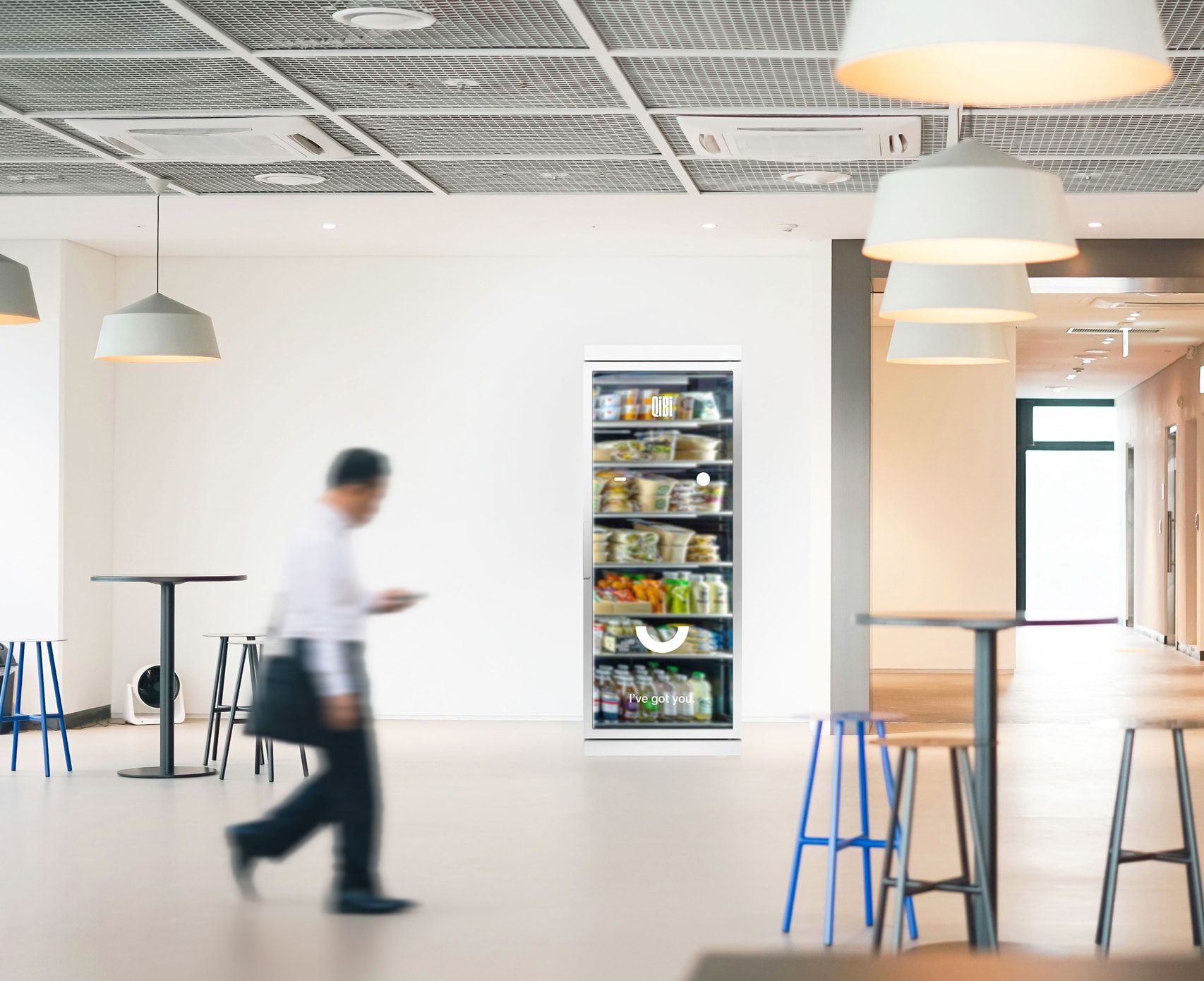
A connected fridge installed on the premises makes it possible to offer fresh meals in self-service, with a subsidy applied automatically. The employer sets its contribution (an amount or a percentage), and the employee only pays the difference, with no manual management and no vouchers to hand out.
This is Qibi's approach: the subsidy is configured in the application, and the debit happens automatically when the door closes. To understand how it works, see our guide to the connected fridge.
How much does it cost the employer?
The cost depends entirely on the chosen subsidy level and the number of employees. The logic is simple: the company sets its contribution per meal (for example a few francs), multiplied by the number of meals taken.
The benefit of modern solutions is budget control: with a connected fridge, the employer sees consumption in real time and can adjust its contribution. There is no waste of unused vouchers, since the subsidy only applies to meals actually taken.
Tax and social treatment: what you need to know
The tax treatment and the treatment under social insurance (AHV/OASI) of a meal subsidy depend on the chosen scheme, the amount and the form of the benefit.
In Switzerland, certain meal-participation schemes benefit from a favourable treatment up to certain ceilings, whereas a cash contribution may be considered a salary component. The rules evolve and vary from case to case. Before setting up a subsidy, it is strongly recommended to confirm the exact treatment with your fiduciary or your AHV compensation fund, in order to optimise the scheme in full compliance.
This paragraph provides general guidance and does not constitute tax advice. Have the amounts and taxation applicable to your situation confirmed.
How to set up a meal subsidy in 4 steps
- Define the objective. Improving purchasing power, employer brand, retention: the objective guides the choice of scheme.
- Choose the formula. Meal vouchers (freedom of location) or on-site catering with subsidy (fresh meals, without going out). The two can be combined.
- Set the contribution. A fixed amount per meal or a percentage of the price, depending on the budget and the tax treatment confirmed.
- Communicate internally. A benefit only has value if it is known and understood. A clear launch maximises take-up.
Meal vouchers or on-site catering: which to choose?
| Criterion | Meal vouchers (Lunch-Check, Reka) | Subsidised on-site catering |
|---|---|---|
| Fresh meals guaranteed | Depends on the outlets | Yes, delivered on site |
| Going out required | Yes | No |
| Application of the subsidy | At purchase, at the partner | Automatic, when the meal is taken |
| Management for the employer | Distribution, balance tracking | Automatic tracking of consumption |
| Ideal for | Mobile teams, offices near shops | Sites without a canteen, staggered hours, poorly served areas |
FAQ
What is an employer meal subsidy?
It is the employer covering all or part of the cost of its employees' meals. It is delivered through meal vouchers, a direct contribution or an on-site catering service partly financed by the company.
What are the main schemes in Switzerland?
Meal vouchers such as Lunch-Check and Reka, the direct contribution to the price of a meal, and on-site catering (canteen, caterer, connected fridge) with a subsidy applied automatically.
Is a meal subsidy subject to AHV and tax?
It depends on the scheme and the amount. Certain schemes benefit from a favourable treatment up to ceilings, others are treated as salary. Have your case confirmed by your fiduciary or your AHV fund.
How to subsidise meals without a canteen?
A connected fridge makes it possible to offer fresh meals in self-service within 1 m², with a subsidy configured in the application and applied automatically, without a canteen or staff.
Can the budget of a meal subsidy be controlled?
Yes. With an on-site solution, the employer sees consumption in real time and only finances the meals actually taken, which avoids the costs linked to unused vouchers.
Offer fresh, subsidised meals to your teams
Qibi installs connected fridges with no commitment and integrates the employer subsidy directly into the application. Your employees access fresh meals at any hour, and you keep control of your contribution and your budget.
To go further
Try Qibi for free
We install it, your teams try it, then you decide. No obligation.
Request a free trialAlready trusted by teams across French-speaking Switzerland.
Read next
