Break time and break room at work in Switzerland: what the law says

In Switzerland, break time at work is governed by the Labour Act (LTr) and its ordinances. The minimum duration of the break depends on the length of the working day: it ranges from 15 minutes to 1 hour. In certain cases, the employer must also provide a suitable room in which to eat and rest. Here are the rules to know, and how to organise your teams' break well.
The legal break durations in Switzerland
The Labour Act sets minimum break durations according to the length of the working day. The reference thresholds are as follows:
| Working duration over the day | Minimum break |
|---|---|
| More than 5 h 30 | 15 minutes |
| More than 7 hours | 30 minutes |
| More than 9 hours | 1 hour |
These durations are legal minimums. A company, a collective agreement or a contract may provide for longer or more favourable breaks.
When a break exceeds a certain duration, it may be split into several moments in the day, according to the terms provided for by the regulations.
These benchmarks reflect the general framework of the Labour Act. Special cases (night work, young workers, specific sectors) are subject to additional rules. In case of doubt, refer to the SECO or to a specialist in employment law.
Are breaks paid?
The main rule comes down to a simple criterion: the possibility of leaving one's workstation.
- If the employee can leave their workstation during the break, it is in principle not counted as working time, and is therefore not paid.
- If the employee must remain at their workstation (for example to monitor a machine or ensure an on-call presence), the break is considered working time and is paid.
This is an important point: the easier it is for your teams to eat on site, without having to monitor anything, the clearer the distinction is.
The obligation to provide a break room
Beyond the duration, the regulations provide that the employer make available suitable rooms so that employees can eat and rest, depending on the size of the company and the nature of the work.
Concretely, this often means a clean, heated room separated from the workstation, allowing people to eat in good conditions. In environments where it is not possible to eat on site (workshops, laboratories, production areas), providing a canteen or a rest room makes full sense.
Here again, the precise requirements depend on the situation. To know your exact obligations, the SECO and the cantonal labour inspectorates are the reference contacts.
Organising the break well: a challenge beyond the law
Complying with the legal durations is a minimum. But the lunch break is also a key moment of the day, which influences quality of life at work and productivity in the afternoon.
Three problems often recur in companies:
- Breaks too short to go out. Between 30 and 45 minutes of break, part of which is lost getting around, there is little time left to eat properly.
- Poorly served sites. Sites far from shops force teams to plan their meals or to lose time travelling.
- Shifted schedules. Evening, night or continuous-shift teams often have no open catering option.
Equipping your break room: the connected fridge solution
A simple way to improve the break is to bring the meal closer to the teams, directly in the break room.
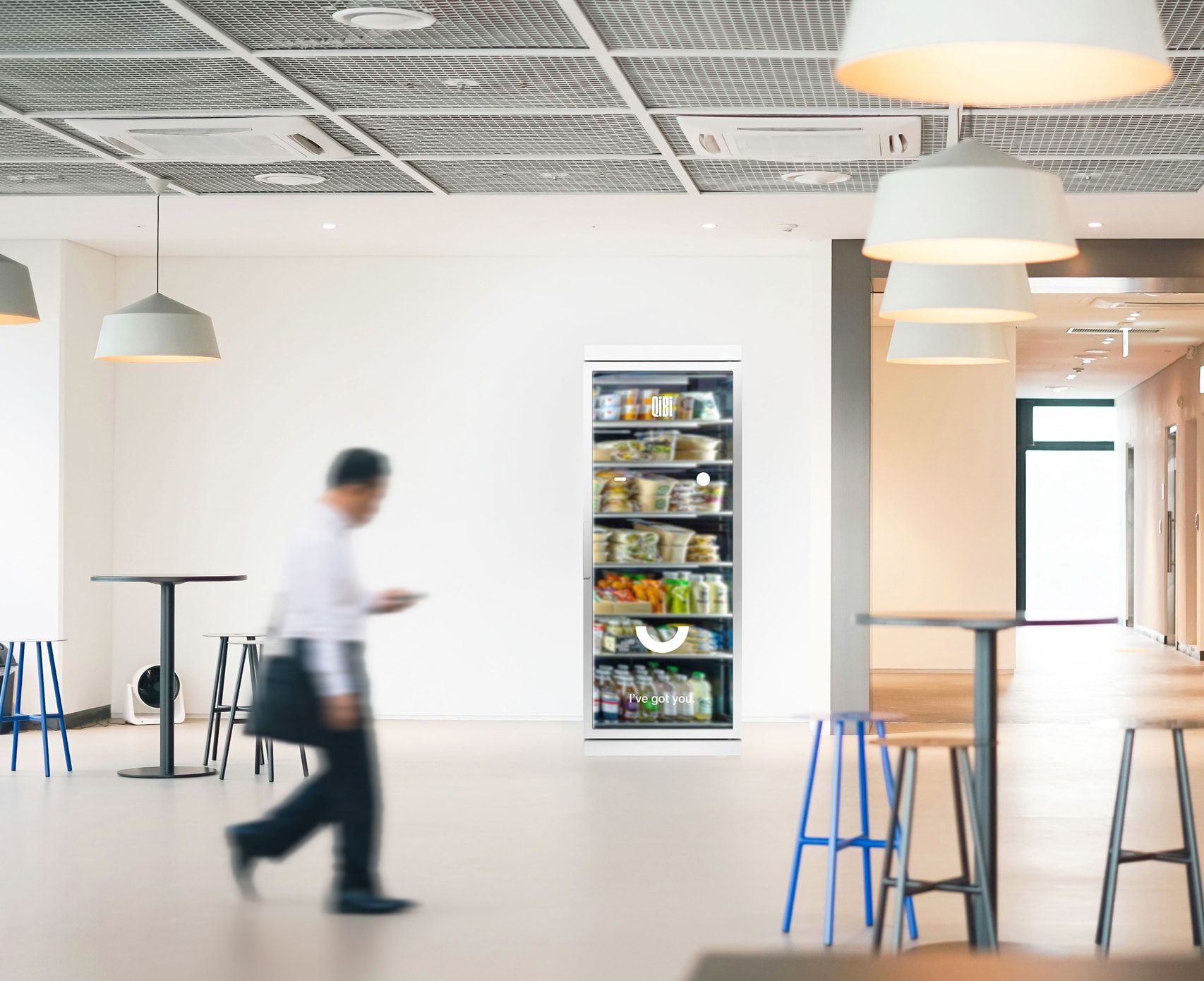
A connected fridge installs in 1 m², with a simple electrical socket, without works. It offers fresh meals and drinks in self-service, accessible at any hour, 24 hours a day. The employee helps themselves, closes the door, and payment is made automatically.
For a break room, the benefit is twofold:
- A real fresh meal on site, without anyone having to go out, even with a short break or a shifted schedule.
- No management for the company: installation, restocking and maintenance are taken care of by the provider.
To understand the operation in detail, see our connected fridge guide.
FAQ
How long is the mandatory break in Switzerland?
According to the Labour Act, the minimum break is 15 minutes for more than 5 h 30 of work, 30 minutes for more than 7 hours, and 1 hour for more than 9 hours. These are minimums, which can be improved by the company.
Are breaks paid in Switzerland?
In principle, a break is not paid if the employee can leave their workstation. If the employee must remain at their workstation, the break is considered working time and is paid.
Must an employer provide a break room?
The regulations provide for making available suitable rooms to eat and rest, depending on the size of the company and the nature of the work. The precise requirements are checked with the SECO or the cantonal labour inspectorate.
How can you improve the lunch break without a canteen?
A connected fridge installed in the break room offers fresh meals in self-service in 1 m², accessible at any hour, without teams having to go out, and without management for the company.
Does the lunch break count as working time?
Only if the employee cannot leave their workstation. Otherwise, it is not counted as working time.
Improve your teams' break, simply
Qibi installs connected fridges in your break room, without commitment and without works. Your employees access fresh meals at any hour, including on shifted schedules.
To go further
- How does a connected fridge work? The complete guide
- Subsidising your employees' meals in Switzerland
This article provides general information about the Swiss legal framework and does not constitute legal advice. For any question relating to your situation, refer to the SECO, the cantonal labour inspectorate or a specialist in employment law.
Try Qibi for free
We install it, your teams try it, then you decide. No obligation.
Request a free trialAlready trusted by teams across French-speaking Switzerland.
Read next
