
How does a connected fridge work in a company? The complete guide

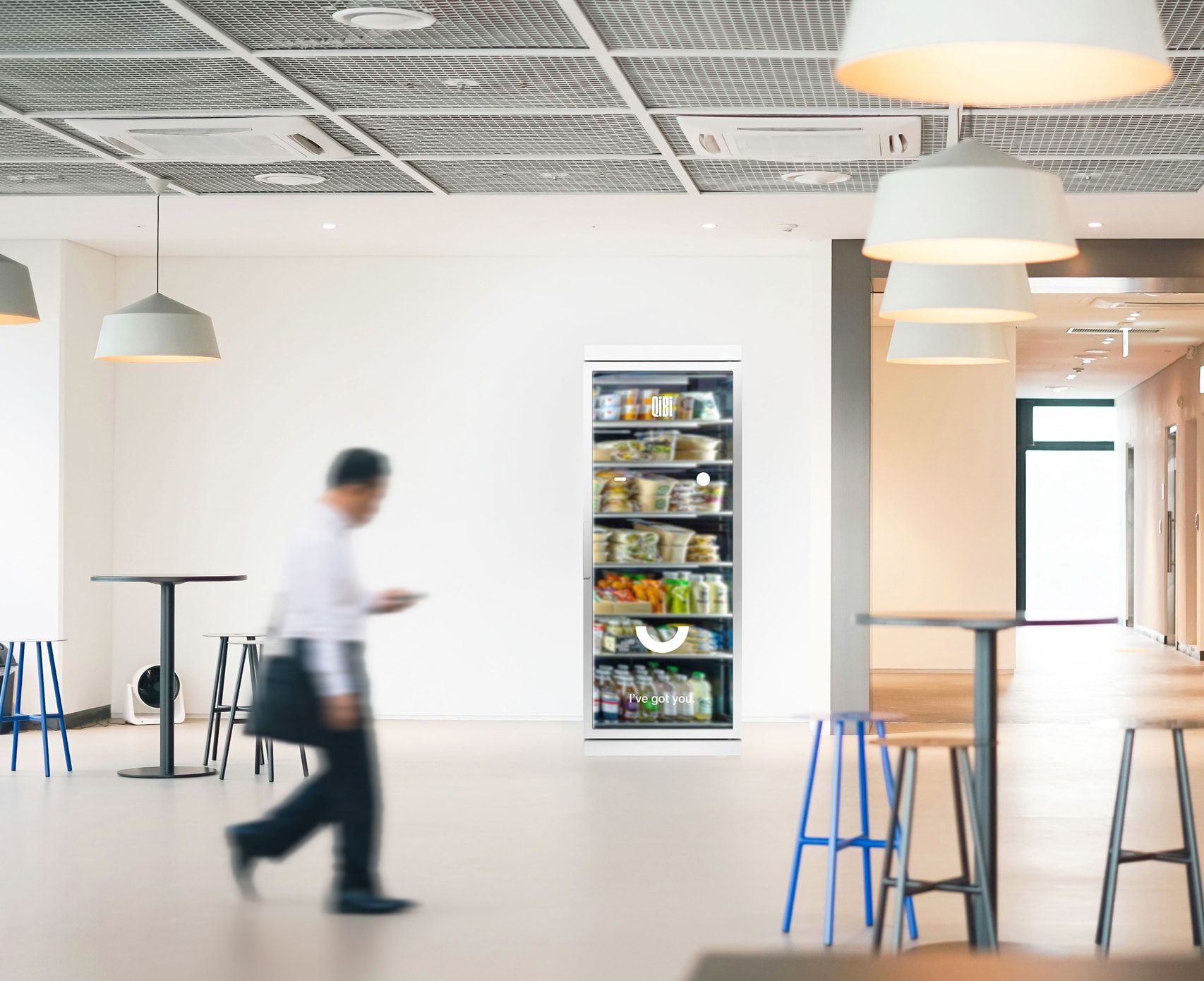
A connected fridge is a self-service refrigerator linked to an application and to sensors that automatically identify the products taken. In a company, it allows every employee to take a fresh meal at any hour and to be billed automatically, without a checkout or staff on site. Here is, in detail, how it works, from the opening of the door to payment.
What is a connected fridge?
A connected fridge is a refrigerator equipped with an internet connection and an identification technology that knows, in real time, what it contains and what is taken from it.
The term in reality covers two very different objects, which must be distinguished before going further:
- The domestic connected fridge: a home refrigerator linked to Wi-Fi, sometimes fitted with an interior camera, a touchscreen, recipe suggestions or an automatic shopping list. The best-known models are the Samsung Family Hub, certain LG or Bosch ranges.
- The company connected fridge: a refrigerated self-service display, installed in the premises of a company, filled with fresh meals and drinks. The employee serves themselves and is billed automatically. This is the model offered by players such as Qibi, Selecta or Foodles.
These two worlds share a word, but not a use. This article focuses on the company connected fridge, the one that replaces a canteen or a vending machine at the office.
Home or company connected fridge: do not confuse them
| Criterion | Home connected fridge | Company connected fridge |
|---|---|---|
| Use | Domestic, one household | Office, collective self-service |
| Flagship function | Interior camera, recipes, shopping list | Fresh meals billed automatically |
| Key technology | Wi-Fi, touchscreen, cameras | RFID or sensors, payment application |
| Who pays | The private individual (at purchase) | The employee (often subsidised by the employer) |
| Examples | Samsung Family Hub, LG, Bosch | Qibi, Selecta, Foodles |
The confusion is frequent because the same expression serves to designate a household appliance and a catering service. The rest of this guide concerns only the second.
How does a connected fridge work in a company?
For the user, everything holds in three moves: open, take, close. Behind this simplicity, three mechanisms follow one another.
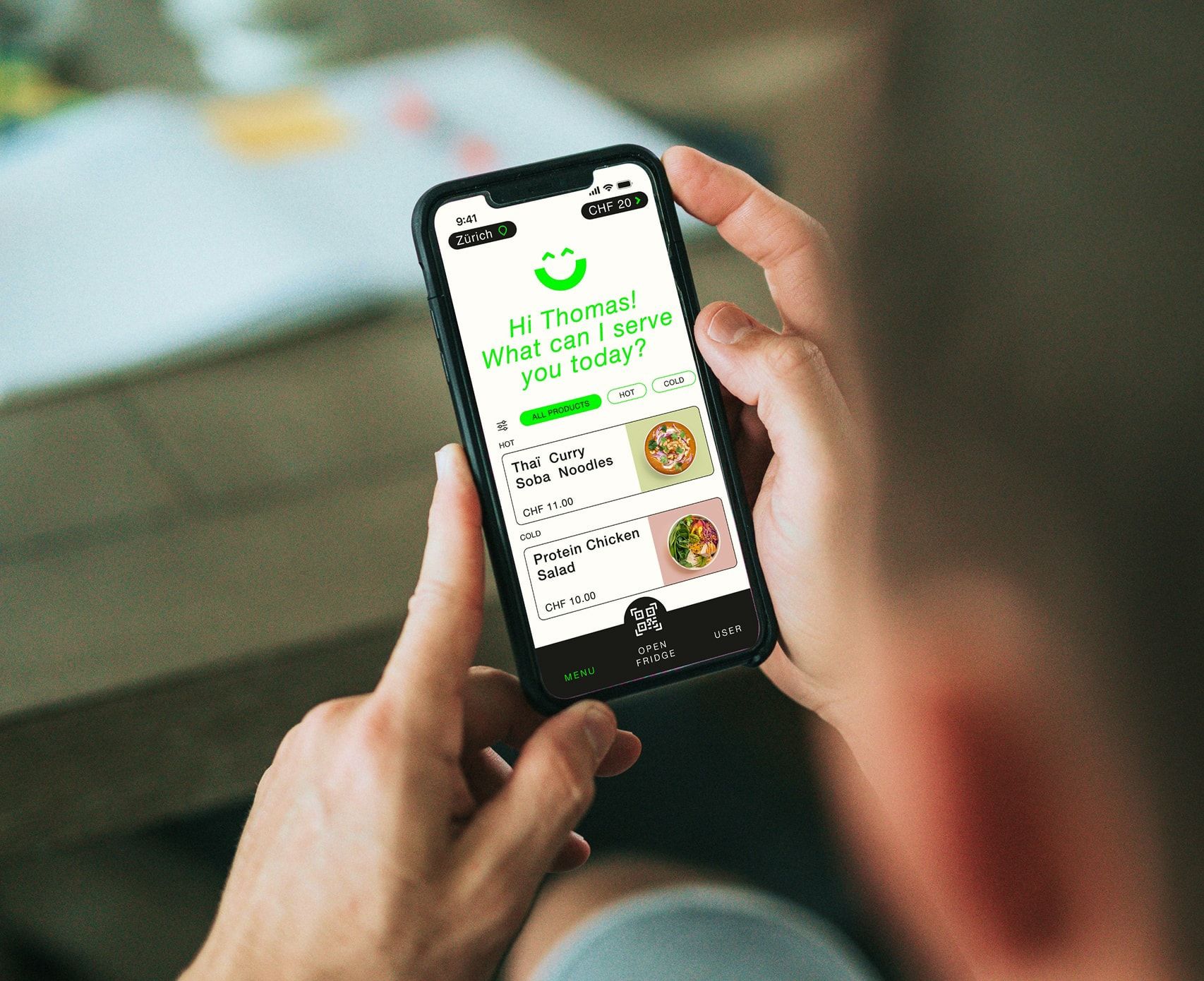
1. Access: opening the door
The fridge stays locked as long as it has not identified the user. Depending on the solution, the opening is done:
- via a mobile application (a scan of a QR code, or a Bluetooth connection),
- via a physical RFID badge,
- sometimes via a bank card or meal vouchers, on certain systems.
This step links the purchase session to a means of payment. It is what then allows billing without a checkout.
2. Detection: what happens when you take an item
This is the technical core, and what distinguishes a connected fridge from a simple vending machine. Three technologies coexist on the market:
- RFID identification: each product carries an electronic tag. Antennas integrated into the fridge read these tags and know exactly what was taken, without contact or line of sight.
- Weight sensors: the shelves weigh the products and deduce what is missing.
- Camera vision: cameras analyse the withdrawals.
On this point, the approaches differ. Certain systems ask the user to scan each item one by one before consuming it. Others, like Qibi, rely on RFID integrated into each package: the system automatically identifies the items taken at the closing of the door, without any scanning item by item. The experience then comes down to opening, taking and closing.
3. Payment: automatic, at closing
Once the door is closed again, the system calculates the basket and debits the employee's account. No queue, no checkout. In Switzerland, the common means of payment are TWINT, Lunch-Check, Reka, the bank card, Apple Pay and Google Pay.
The employer can subsidise all or part of the meals. The subsidy is then applied automatically, without manual management.
The technologies behind the connected fridge
Beyond the experience, a connected fridge relies on three building blocks.
Automatic identification. RFID, weight sensors or vision: each has its strengths. RFID is fast and reliable even at high throughput, and allows an instant reading of several items at once, which removes the manual scan.
Connectivity. The fridge communicates via autonomous 4G or via network cable (Ethernet/RJ45) if the building blocks the signal. It is this link that transmits the sales and the state of the stocks in real time.
Remote stock tracking. The manager sees, at any moment, what is left in each fridge. The restocking is driven by the data, which avoids shortages.
The installation: 1 sq m, one socket, plug & play
A connected fridge does not require any works. It is installed on 1 sq m of floor space, with a simple domestic electrical socket. No plumbing, no water connection, no construction site.
- Typical footprint: about 75 × 198 × 78 cm.
- Consumption: on the order of 1.2 kWh per day.
- Connection: autonomous 4G or Ethernet cable.
- Commissioning: about one hour.
That is what makes it a solution suited to offices without a canteen or a kitchen: there, where building a catering space would be impossible or prohibitively expensive, one square metre is enough.
Restocking and freshness
The fridge is restocked regularly, most often every working day, with fresh dishes and drinks. The stocks being tracked remotely, the offer adjusts to the real consumption of the site. The menu rotates to avoid weariness. Depending on the providers, the unsold items are put to use (end-of-day promotions, donations, anti-waste platforms).
Connected fridge, vending machine or canteen: what differences?
To feed a team on site, three solutions coexist. The connected fridge sits between the vending machine and the classic canteen, by borrowing the advantages of both.
| Criterion | Vending machine | Classic canteen | Connected fridge |
|---|---|---|---|
| Offer | Industrial snacks and drinks | Hot meals cooked on site | Fresh cooked meals, snacks and drinks |
| Staff on site | No | Yes (kitchen and service) | No |
| Hours | 24/24 | Service hours | 24/24 |
| Space and works | Small, no works | Significant (kitchen to build) | 1 sq m, no works |
| Freshness | Low | High | High |
| Cost for the company | Low | High | Moderate (fridge made available) |
| Ideal for | The snack stopgap | The large sites | The SMEs without a kitchen and the shifted hours |
Clearly: the vending machine helps out but does not really feed, the canteen feeds well but costs a lot and supposes space and staff, and the connected fridge aims for the best compromise between freshness, simplicity and cost.
Advantages and disadvantages of a connected fridge
No solution is perfect. Here is a balanced view.
The advantages
- Access 24/24, 7/7, including for the shifted hours and night work.
- Fresh meals on site, without having to go out or order in advance.
- Zero service staff and zero management for the company: installation, restocking, maintenance and support are handled by the provider.
- A smooth experience: no queue, no checkout, automatic payment.
- Less waste thanks to the tracking of stocks and the use of unsold items.
The disadvantages
- A dependence on the connection and on electricity: like any connected object, the fridge needs a network and a power supply.
- On the systems with scanning item by item, a forgotten scan can be re-billed, sometimes at a flat amount. The systems with RFID without scanning remove this risk.
- An offer limited to what is in stock: the choice depends on the restocking, unlike a restaurant.
- For the general public, the domestic models with a screen and camera remain expensive, which however has nothing to do with the company model, made available by the provider.
For which companies does a connected fridge make sense?
The connected fridge answers above all precise contexts:
- the SMEs without a canteen, where building a catering space is not profitable,
- the sites with shifted hours (three-shift production, health, security), which need meals at any hour,
- the offices located in poorly served zones, far from shops,
- the companies that want to strengthen their employer brand and the quality of life at work without increasing the load of the HR teams.
How to choose a connected fridge for one's company?
Beyond how it works, a few criteria make the difference in use. Here are those that really count.
- The access and payment technology. Do you have to scan each item, or is the billing automatic (RFID without scanning)? Are the local means of payment accepted (TWINT, Lunch-Check, Reka)?
- The freshness and the origin of the dishes. Are the meals cooked in-house or by a network of caterers? At what frequency is the fridge restocked?
- The variety and the renewal of the menu. How many dishes per week, and does the menu rotate enough to avoid weariness?
- The local anchoring and the responsiveness. Is the provider close, able to come and present its dishes and adjust the offer to your site?
- The contractual conditions. Is a trial or a tasting without commitment possible? What is the length of the commitment? Are the prices transparent?
- The CSR approach. Which packaging, which management of unsold items, which labels (organic, IP-Suisse, MSC)?
The best way to decide remains to have your teams taste the solution. No spec sheet replaces the opinion of the employees after a real trial week. To compare the main Swiss players, see our comparison Felfel vs Qibi vs Feel Eat.
FAQ
What is a connected fridge? A connected fridge is a refrigerator linked to the internet and equipped with an identification technology (RFID, sensors or cameras) that automatically detects the products taken. In a company, it works in self-service: you serve yourself and are billed automatically, without staff on site.
How does a connected fridge work? You open the door with an application or a badge, you take what you want, you close it again. The system identifies the items taken and automatically debits the user's account. On the solutions with RFID without scanning, there is no barcode to scan.
What is a connected fridge for in a company? To offer fresh meals and drinks at the workplace, accessible at any hour, without a canteen, without a kitchen and without service staff. It is an alternative to the classic canteen and the vending machine.
What are the disadvantages of a connected fridge? It depends on a connection and a power supply. On the systems that impose scanning each item, a lapse can be re-billed. The offer is limited to what is in stock. The domestic models with a screen also remain costly.
What difference between a home connected fridge and a company connected fridge? The home model is a household appliance (Wi-Fi, camera, recipes). The company model is a self-service catering service, with fresh meals billed automatically and a restocking ensured by a provider.
Do you have to scan each product? That depends on the solution. Certain systems ask you to scan each item. Others, like Qibi, use RFID: the items are identified automatically at the closing of the door, without scanning.
What space and what consumption should be planned? About 1 sq m of floor space and a simple electrical socket. The consumption is on the order of 1.2 kWh per day. No works are necessary.
Want to see a connected fridge for real?
The best way to understand a connected fridge is to try it. Qibi installs its fridges without commitment and offers tastings on site, so that your teams test the dishes before any decision.
To go further
Try Qibi for free
We install it, your teams try it, then you decide. No obligation.
Request a free trialAlready trusted by teams across French-speaking Switzerland.